
Research Guides
GLP-1 Research Peptides Explained: Semaglutide, Tirzepatide & Retatrutide
Jul
The Fastest-Moving Category in Metabolic Research
GLP-1 research peptides UK-wide have moved faster than any other research category over the past few years. What started as single-target GLP-1 receptor agonism has expanded into dual and now triple-receptor agonist compounds, each building on the research established by the one before it. This guide walks through the three compounds we stock most — Semaglutide, Tirzepatide, and Retatrutide — and explains how their research mechanisms actually differ.
The Starting Point: What Is GLP-1?
GLP-1 (glucagon-like peptide-1) is a naturally occurring incretin hormone involved in glucose metabolism and appetite regulation. Its natural form has an extremely short half-life, which limited its usefulness as a research subject until scientists developed structurally modified analogues designed to remain active for much longer. That modification effort is what produced Semaglutide, and it’s the foundation the rest of this research category is built on.
Semaglutide: The Single-Target GLP-1 Agonist
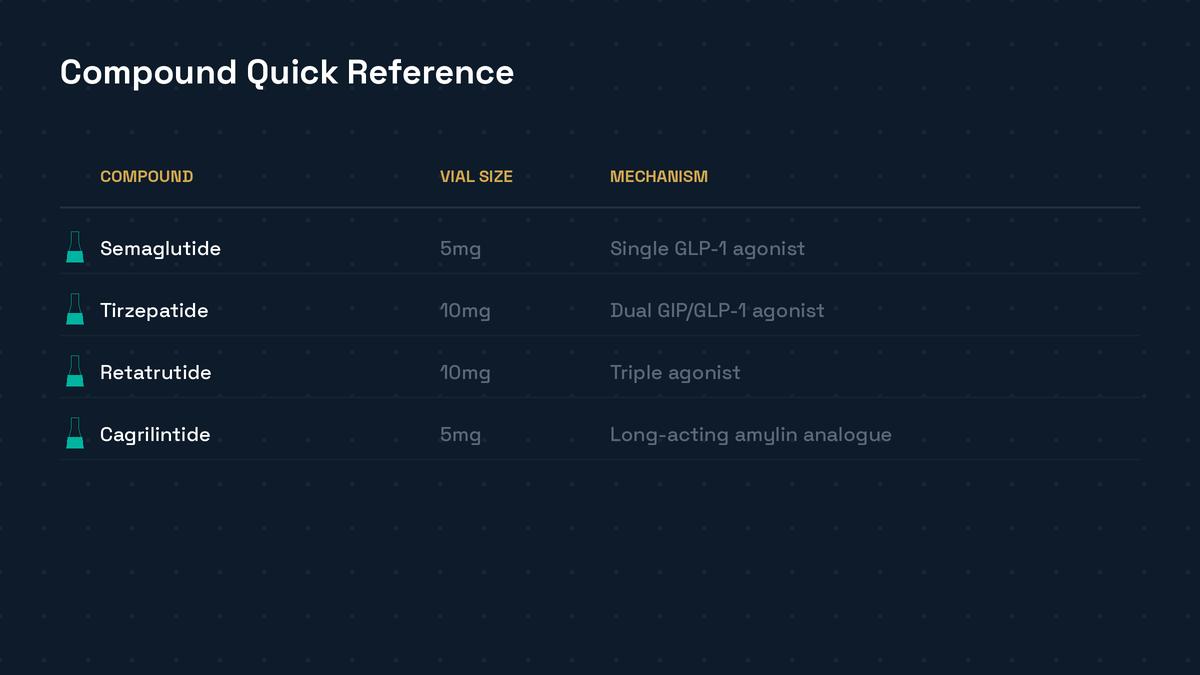
Semaglutide is a synthetic GLP-1 receptor agonist, and remains one of the most extensively studied compounds in metabolic research literature. Research has focused on glucose-metabolism pathways, appetite-regulation models, and comparative incretin research. Full research detail, purity testing, and storage guidance is available on our Semaglutide 5mg product page.
Tirzepatide: Adding a Second Receptor Pathway
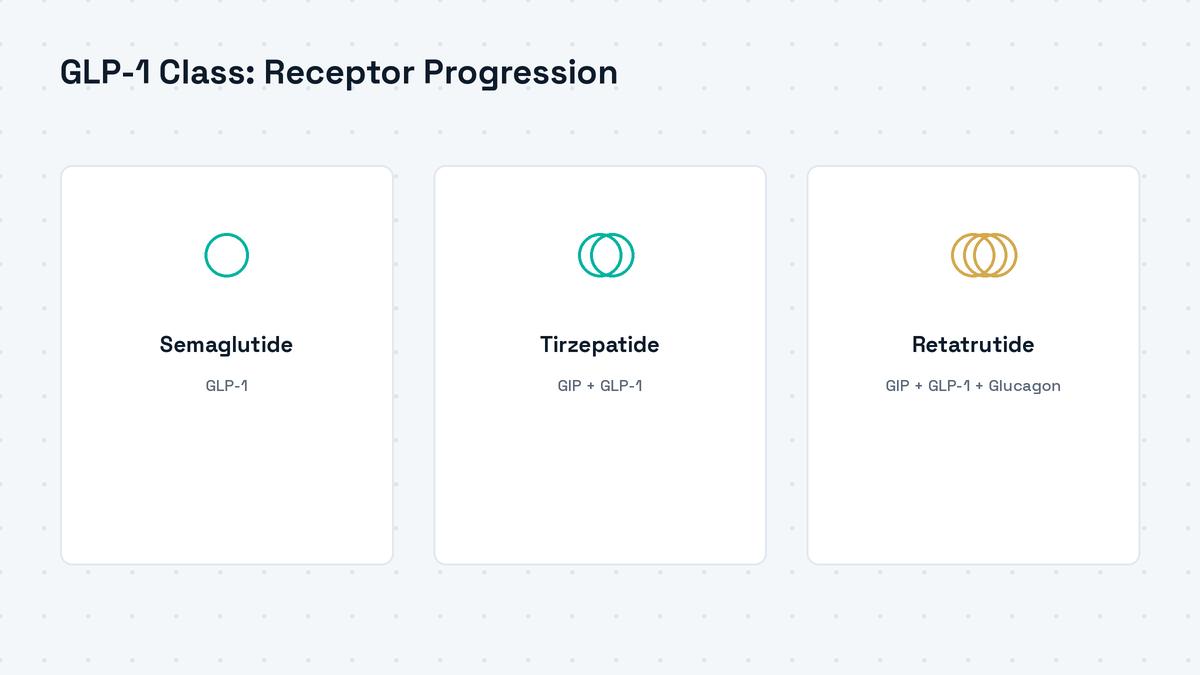
Tirzepatide extends the single-target approach by acting as a dual agonist across both GIP (glucose-dependent insulinotropic polypeptide) and GLP-1 receptors simultaneously. Research has explored whether this combined receptor activation produces additive or different effects compared with GLP-1-only agonism, positioning Tirzepatide as a distinct research subject rather than simply a “stronger” version of Semaglutide. Full detail is on our Tirzepatide 10mg product page.
Retatrutide: The Triple-Agonist Research Compound
Retatrutide extends the mechanism further still, engaging GIP, GLP-1, and glucagon receptors together. The addition of glucagon receptor agonism is the key research variable that distinguishes it from the dual-agonist class, and current literature is particularly focused on whether this third pathway contributes additional energy-expenditure effects beyond what GIP/GLP-1 activation alone produces. Full detail is on our Retatrutide 10mg product page.
Side-by-Side Comparison
| Compound | Receptor Targets | Research Generation |
|---|---|---|
| Semaglutide | GLP-1 (single) | Foundational |
| Tirzepatide | GIP + GLP-1 (dual) | Second-generation |
| Retatrutide | GIP + GLP-1 + Glucagon (triple) | Most recent |
A Related Compound Worth Knowing: Cagrilintide
Separate from the GIP/GLP-1/glucagon family, Cagrilintide is a long-acting amylin receptor agonist, frequently studied in combination with GLP-1 pathway compounds. Because amylin is a distinct hormonal pathway from GIP and GLP-1, combined amylin/GLP-1 research protocols are a frequent subject in current metabolic literature. See our Cagrilintide 5mg product page for full detail.
Purity Considerations for This Category
GLP-1 class compounds are among the most scrutinised in today’s research market, and unfortunately among the most frequently misrepresented by suppliers cutting corners on testing. Every GLP-1 class compound ApexPure sells — Semaglutide, Tirzepatide, Retatrutide, and Cagrilintide — is independently HPLC-verified to a minimum of 99% purity, with a batch-specific Certificate of Analysis available on each product page. Given the price point and research value of this category, we’d argue this is exactly where independent testing matters most, not least.
Frequently Asked Questions
Is Tirzepatide simply a “stronger” version of Semaglutide?
Not quite — they act through different receptor combinations, which is a distinct research variable rather than a simple potency difference. Comparative research treats them as mechanistically distinct subjects.
Which GLP-1 class compound is most established in the literature?
Semaglutide has the longest research history of the three, as the foundational single-target GLP-1 agonist the later compounds built upon.
Are these compounds legal to purchase for research in the UK?
Yes, when sold and purchased strictly as unlicensed research chemicals for laboratory use only, in line with current UK regulation. None are supplied for human consumption or clinical use.
This article is provided for general research and informational purposes only. All compounds referenced are sold by ApexPure strictly for laboratory and in-vitro research use. Not for human or veterinary consumption, diagnostic, or therapeutic use.
