Oct
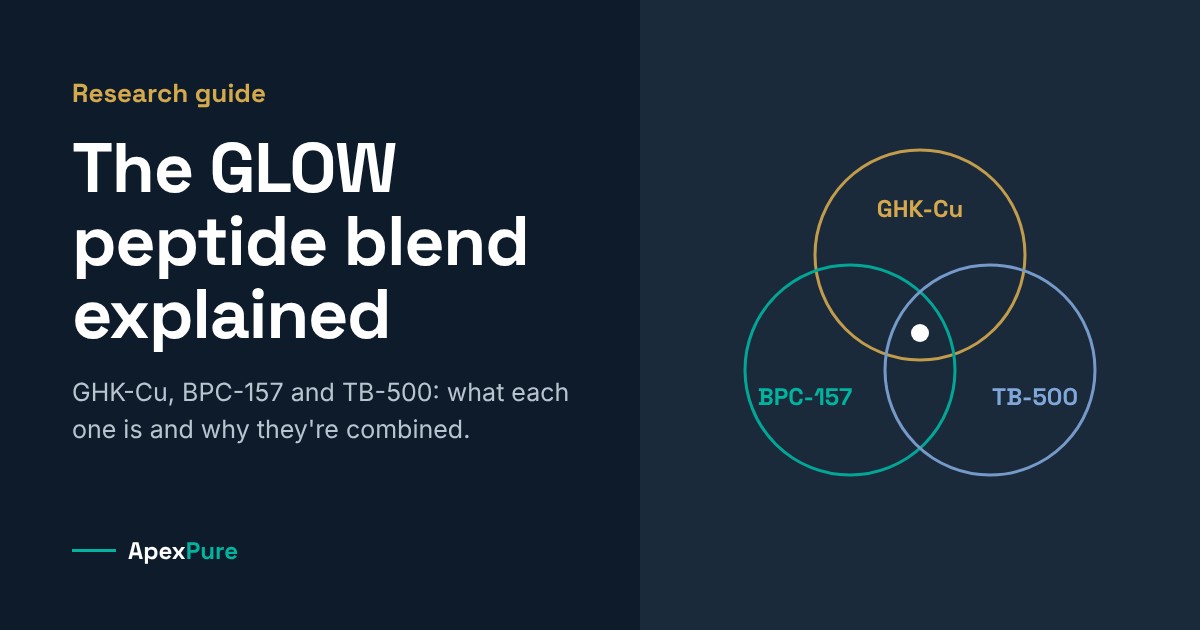
The glow peptide blend is one of the most talked-about peptide combinations in research. It brings together three compounds, GHK-Cu, BPC-157 and TB-500, in a single vial. Each has its own body of research, and each is studied for a different part of how tissue repairs and remodels.
This guide explains what’s in a GLOW blend, what each component is, the research behind them, how GLOW differs from the similar KLOW blend, and how to handle it in the lab.
What’s in the Glow peptide blend?
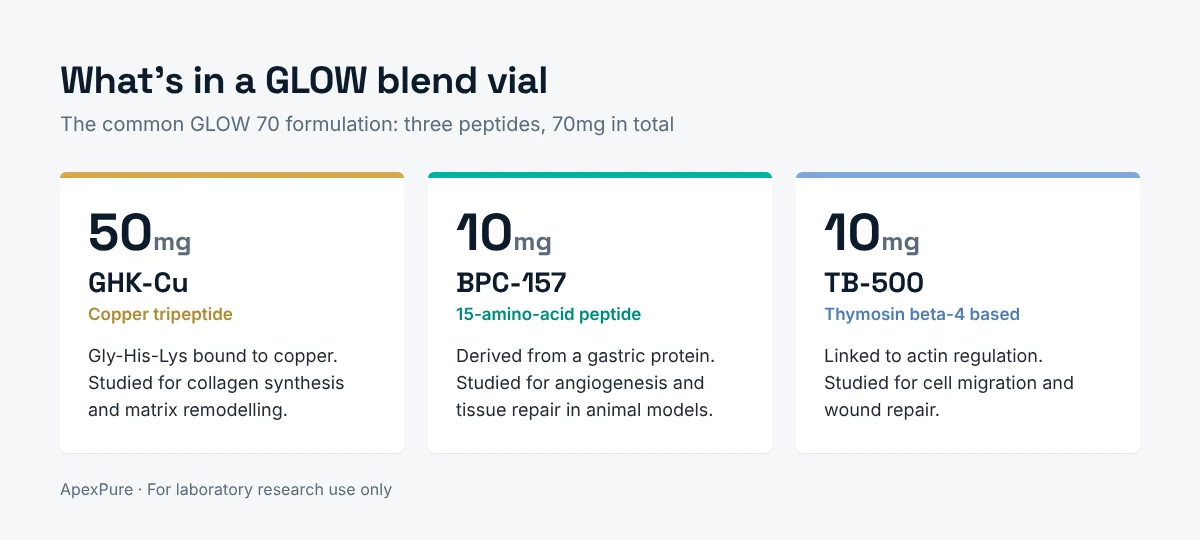
The most common GLOW formulation, often sold as GLOW 70, contains 70mg of peptide in total:
| GHK-Cu | BPC-157 | TB-500 | |
|---|---|---|---|
| Amount (GLOW 70) | 50mg | 10mg | 10mg |
| Type | Copper-binding tripeptide | 15-amino-acid peptide | Thymosin beta-4 based peptide |
| Sequence | Gly-His-Lys + Cu²⁺ | Gly-Glu-Pro-Pro-Pro-Gly-Lys-Pro-Ala-Asp-Asp-Ala-Gly-Leu-Val | Based on thymosin beta-4 (see below) |
| Molecular weight | ≈ 401.9 g/mol | ≈ 1,419.5 g/mol | Depends on form |
| Main research focus | Collagen synthesis, matrix remodelling | Angiogenesis, tissue repair | Cell migration, wound repair |
GHK-Cu: the copper peptide
GHK is a naturally occurring tripeptide (glycine-histidine-lysine) first identified in human plasma in 1973 by Dr Loren Pickart. It has a strong affinity for copper, and the copper-bound form, GHK-Cu, is the one most widely studied.
In laboratory and animal research, GHK-Cu has been associated with increased synthesis of collagen and other components of the extracellular matrix, along with roles in wound healing and antioxidant activity. Gene-expression studies have also suggested that it influences the activity of a large number of human genes linked to tissue repair. In cosmetic science it’s classed as a carrier peptide, because it delivers copper, a trace element that enzymes involved in collagen formation depend on.
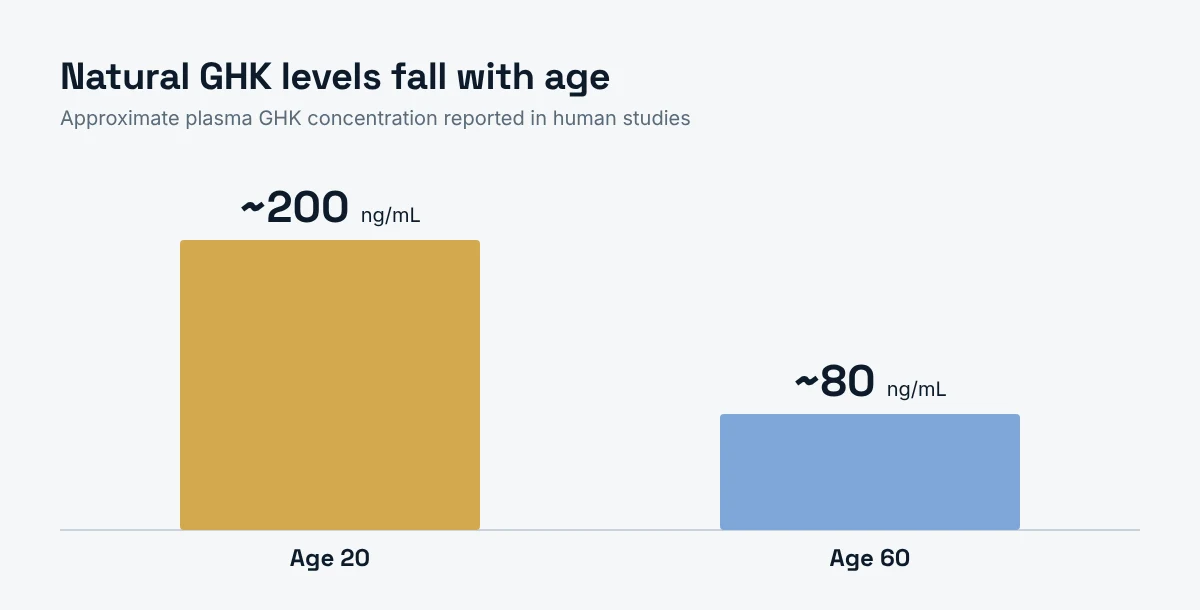
One reason GHK-Cu attracts so much research interest is that natural levels decline with age:
BPC-157: the gastric peptide
BPC-157 stands for “Body Protection Compound 157”. It’s a synthetic 15-amino-acid peptide whose sequence is derived from a protein found in human gastric juice. Unlike many peptides, it’s notably stable in gastric conditions, which is part of what first drew researchers to it.
Most BPC-157 research has been carried out in rodent models, where it has been studied for effects on tendon, ligament, muscle and gut tissue, and for promoting angiogenesis, the formation of new blood vessels that supply healing tissue. It’s worth knowing that a large share of the published work comes from a single research group, and controlled human data remains very limited.
TB-500: the thymosin beta-4 peptide
TB-500 is the name used for a synthetic peptide based on thymosin beta-4 (Tβ4), a 43-amino-acid protein found in almost all human cells. Depending on the supplier, “TB-500” may refer to the full Tβ4 sequence or to a short fragment of it (LKKTETQ), the region responsible for binding actin.
Actin is the protein that forms a cell’s internal scaffolding. By regulating it, thymosin beta-4 influences how cells move. In research models, Tβ4 has been studied for promoting cell migration into damaged areas, as well as for wound repair and new blood vessel formation.
Why combine all three?
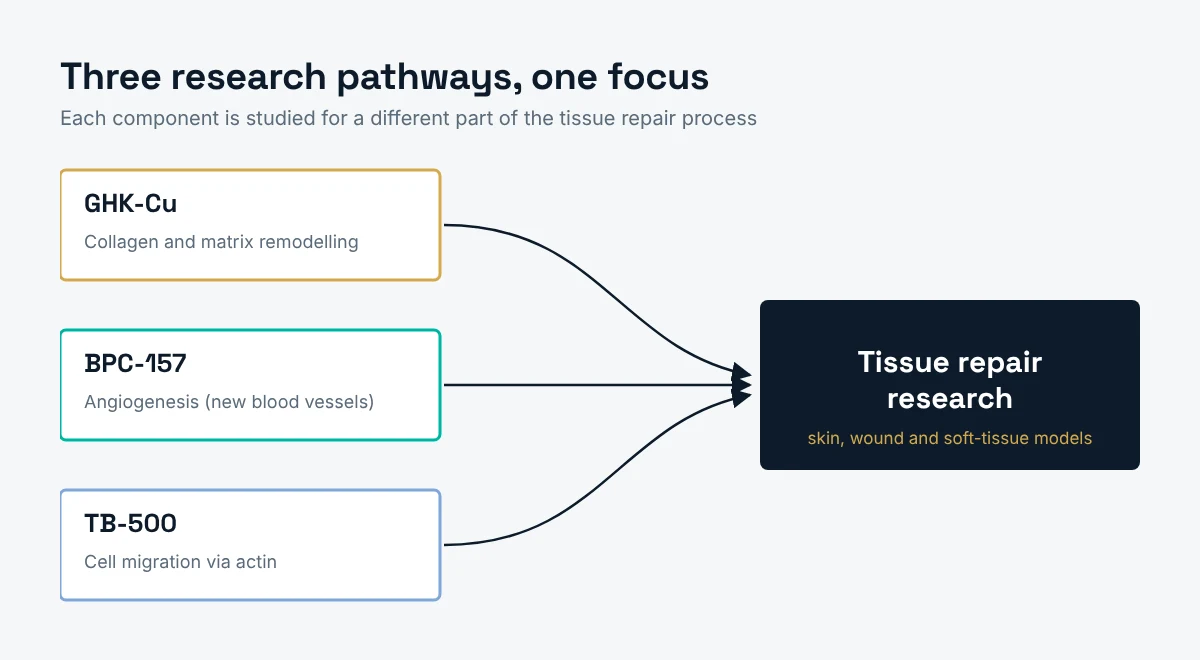
The rationale for the GLOW blend is that each component targets a different stage of tissue repair, so together they cover more of the process than any one alone:
- TB-500 is studied for helping cells migrate into a damaged area.
- BPC-157 is studied for supporting the new blood supply that tissue needs to repair.
- GHK-Cu is studied for rebuilding and remodelling the collagen matrix.
Worth knowing: each peptide has its own research history, but there’s very little published research on the three combined. The case for GLOW rests on their individual profiles, so researchers often design studies to compare the blend against its single components.
GLOW vs KLOW: what’s the difference?
KLOW is a closely related blend that contains the same three peptides plus a fourth: KPV, a tripeptide (lysine-proline-valine) taken from the end of alpha-melanocyte-stimulating hormone (α-MSH). KPV is studied mainly for its anti-inflammatory activity, so KLOW adds an inflammation-focused component to GLOW’s repair-focused trio.
| GLOW | KLOW | |
|---|---|---|
| GHK-Cu | Yes | Yes |
| BPC-157 | Yes | Yes |
| TB-500 | Yes | Yes |
| KPV | No | Yes |
| Research emphasis | Tissue repair and matrix remodelling | Repair plus inflammation signalling |
Handling and storage
- Store lyophilised vials at −20 °C for long-term stability, protected from light and moisture.
- Let the vial reach room temperature before opening, so condensation doesn’t form on the powder.
- GHK-Cu gives reconstituted solutions a characteristic blue tint, which comes from the copper and is expected.
- Keep reconstituted solutions at 2–8 °C, use them promptly, and avoid repeated freeze-thaw cycles.
Purity matters more in a blend
With three peptides in one vial, verifying each component is harder than with a single compound. A reliable blend should come with testing that confirms the identity of each peptide by mass spectrometry, not just an overall purity figure. Read how we verify every batch on our Lab Testing page.
Prefer single compounds? See BPC-157 5mg and TB-500.
Frequently asked questions
What is the GLOW peptide blend?
GLOW is a research blend of three peptides, GHK-Cu, BPC-157 and TB-500, combined in one vial. The most common version, GLOW 70, contains 50mg GHK-Cu, 10mg BPC-157 and 10mg TB-500.
What does GLOW 70 mean?
The number refers to the total peptide content of the vial in milligrams: 50mg GHK-Cu plus 10mg each of BPC-157 and TB-500.
What is the difference between GLOW and KLOW?
KLOW contains the same three peptides as GLOW plus KPV, a tripeptide derived from alpha-MSH that is studied for anti-inflammatory activity.
Why is reconstituted GLOW blue?
The blue colour comes from the copper in GHK-Cu. It’s normal and expected for any solution containing copper peptides.
How should the GLOW blend be stored?
Store lyophilised vials at −20 °C away from light and moisture. Keep reconstituted solutions at 2–8 °C and avoid repeated freeze-thaw cycles.
More research guides: Ipamorelin vs Sermorelin and SNAP-8 vs Argireline vs Matrixyl 3000.
All ApexPure products are supplied strictly for laboratory research use only. They are not intended for human or veterinary use, diagnosis or treatment. See our Research Disclaimer.
