
Research Guides
SNAP-8 vs Argireline vs Matrixyl 3000
Oct
argireline SNAP-8 and Matrixyl 3000 are three of the most widely studied peptides in cosmetic science. They’re often mentioned together, but they don’t all work the same way. Two of them act on nerve signalling, and one acts on the skin’s structural proteins.
This guide explains what each peptide is, how their structures relate, the mechanisms behind them, and why formulation researchers so often study them side by side.
snap-8 vs argireline At a glance
| Argireline | SNAP-8 | Matrixyl 3000 | |
|---|---|---|---|
| INCI name | Acetyl hexapeptide-8 | Acetyl octapeptide-3 | Palmitoyl tripeptide-1 + palmitoyl tetrapeptide-7 |
| Length | 6 amino acids | 8 amino acids | 3 + 4 amino acids |
| Molecular weight | ≈ 889.0 g/mol | ≈ 1,075.2 g/mol | ≈ 578.8 and ≈ 694.9 g/mol |
| Peptide class | Neurotransmitter-modulating | Neurotransmitter-modulating | Signal peptide (matrikine) |
| Research target | SNARE complex (SNAP-25 mimic) | SNARE complex (SNAP-25 mimic) | Fibroblast signalling and extracellular matrix |
| Solubility | Water-soluble | Water-soluble | Lipophilic (palmitoyl groups) |
What is Argireline?
Argireline is the trade name for acetyl hexapeptide-8 (previously listed as acetyl hexapeptide-3), a synthetic six-amino-acid peptide with the sequence Ac-Glu-Glu-Met-Gln-Arg-Arg-NH2.
Its sequence is modelled on the N-terminal end of SNAP-25, one of the proteins that make up the SNARE complex. Nerve cells need that complex to fuse vesicles with the cell membrane and release neurotransmitters such as acetylcholine. Its anti-wrinkle activity was first described in a 2002 paper in the International Journal of Cosmetic Science, which made it one of the earliest well-characterised cosmetic peptides.
What is SNAP-8?
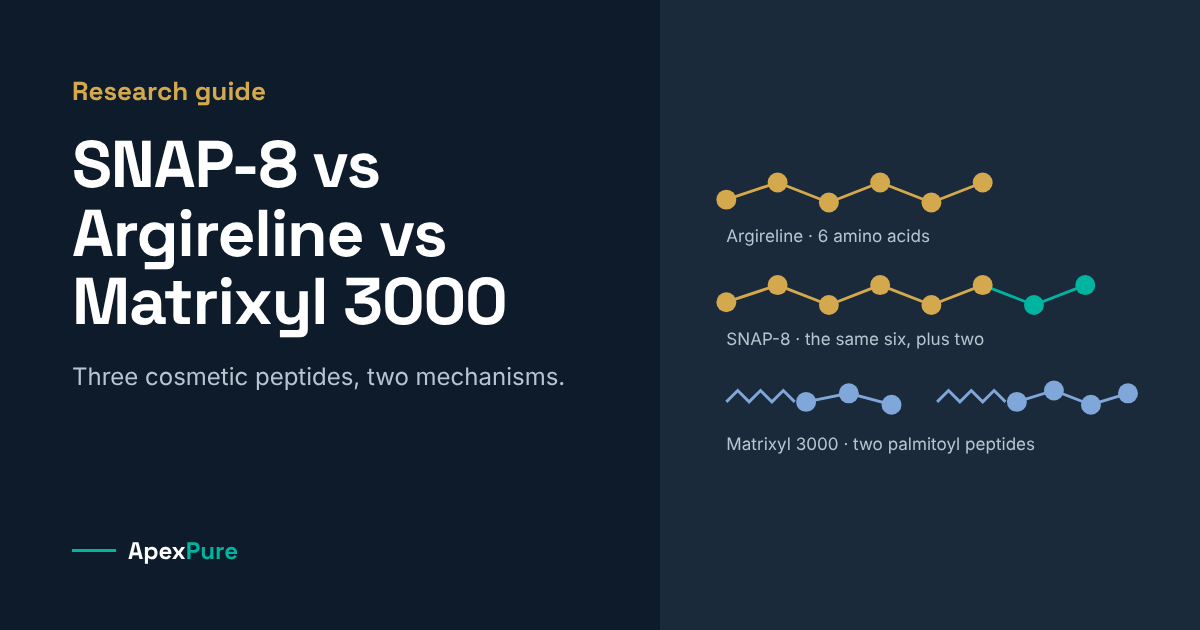
SNAP-8 is acetyl octapeptide-3. It was designed as an extension of Argireline: the same six-residue sequence with two additional amino acids, alanine and aspartic acid, added to the end.
The idea behind the longer chain is that it mimics a longer stretch of SNAP-25, so it can compete more effectively for a place in the SNARE complex. Manufacturer-reported in vitro data suggested greater activity than Argireline, but published independent head-to-head studies are limited. Researchers usually treat SNAP-8 as a refined variant, not a different kind of peptide.
What is Matrixyl 3000?
Matrixyl 3000 isn’t a single peptide. It’s a combination of two lipopeptides:
- Palmitoyl tripeptide-1 (Pal-Gly-His-Lys), based on the GHK sequence, a fragment of collagen.
- Palmitoyl tetrapeptide-7 (Pal-Gly-Gln-Pro-Arg), a fragment related to immunoglobulin G.
Both belong to a class called matrikines: small peptide fragments released when the skin’s structural proteins break down, which signal the tissue to repair itself. In fibroblast culture studies, the GHK-based component has been associated with increased synthesis of collagen and other extracellular matrix components, while palmitoyl tetrapeptide-7 has been studied for its effect on inflammatory signalling such as interleukin-6.
The palmitoyl group, a 16-carbon fatty acid attached to each peptide, makes the molecules more lipophilic. Researchers study this as a way to improve penetration through the lipid-rich outer layer of the skin.
Two mechanisms, side by side
The key distinction is where each peptide acts. Argireline and SNAP-8 are studied for their effect on the signal that tells muscle to contract. Matrixyl 3000 is studied for its effect on the structural matrix of the skin itself.
Why they’re often studied together
Because the two mechanisms don’t overlap, researchers frequently combine a neurotransmitter-modulating peptide with a signal peptide in the same formulation study. One addresses the repeated muscle movement associated with expression lines. The other addresses the gradual loss of collagen associated with structural ageing. A common research question is whether pairing them produces additive effects in skin models.
Choosing for a study: Argireline is the established reference compound for SNARE-related research. SNAP-8 suits work comparing chain length and activity within the same mechanism. Matrixyl 3000 suits research into extracellular matrix signalling and fibroblast activity.
Handling and storage
- Store lyophilised vials at −20 °C for long-term stability, protected from light and moisture.
- Let the vial reach room temperature before opening, so condensation doesn’t form on the powder.
- Argireline and SNAP-8 dissolve readily in water. The palmitoyl groups make Matrixyl 3000 components less water-soluble, so formulation work often uses a suitable co-solvent.
- Keep reconstituted solutions at 2–8 °C, use them promptly, and avoid repeated freeze-thaw cycles.
Purity and verification
Because SNAP-8 and Argireline share an identical six-residue core, a truncated SNAP-8 synthesis can look very similar to Argireline. That’s why identity confirmation by mass spectrometry matters as much as HPLC purity. The two compounds differ by roughly 186 g/mol, which mass spectrometry separates easily. See how each batch is verified on our Lab Testing page.
Frequently asked questions
What is the difference between SNAP-8 and Argireline?
SNAP-8 (acetyl octapeptide-3) is Argireline (acetyl hexapeptide-8) extended by two amino acids, alanine and aspartic acid. Both mimic part of the SNAP-25 protein and act on the same SNARE mechanism. SNAP-8’s longer chain was designed to mimic more of that protein.
Is Matrixyl 3000 the same type of peptide as Argireline?
No. Argireline is a neurotransmitter-modulating peptide that acts on nerve signalling. Matrixyl 3000 is a blend of two signal peptides (matrikines) studied for stimulating fibroblasts to produce collagen and other matrix proteins.
What peptides are in Matrixyl 3000?
Matrixyl 3000 combines palmitoyl tripeptide-1 (Pal-Gly-His-Lys) and palmitoyl tetrapeptide-7 (Pal-Gly-Gln-Pro-Arg).
Can these peptides be studied together?
Yes. Because they act through different mechanisms, combining a neurotransmitter-modulating peptide with a signal peptide is a common approach in cosmetic formulation research.
How should cosmetic research peptides be stored?
Store lyophilised vials at −20 °C away from light and moisture. Keep reconstituted solutions at 2–8 °C and avoid repeated freeze-thaw cycles.
Interested in growth hormone research peptides? Read our comparison of Ipamorelin vs Sermorelin.
All ApexPure products are supplied strictly for laboratory research use only. They are not intended for human or veterinary use, diagnosis or treatment. See our Research Disclaimer.
